The Radiant Nucleus of Liviana Dan
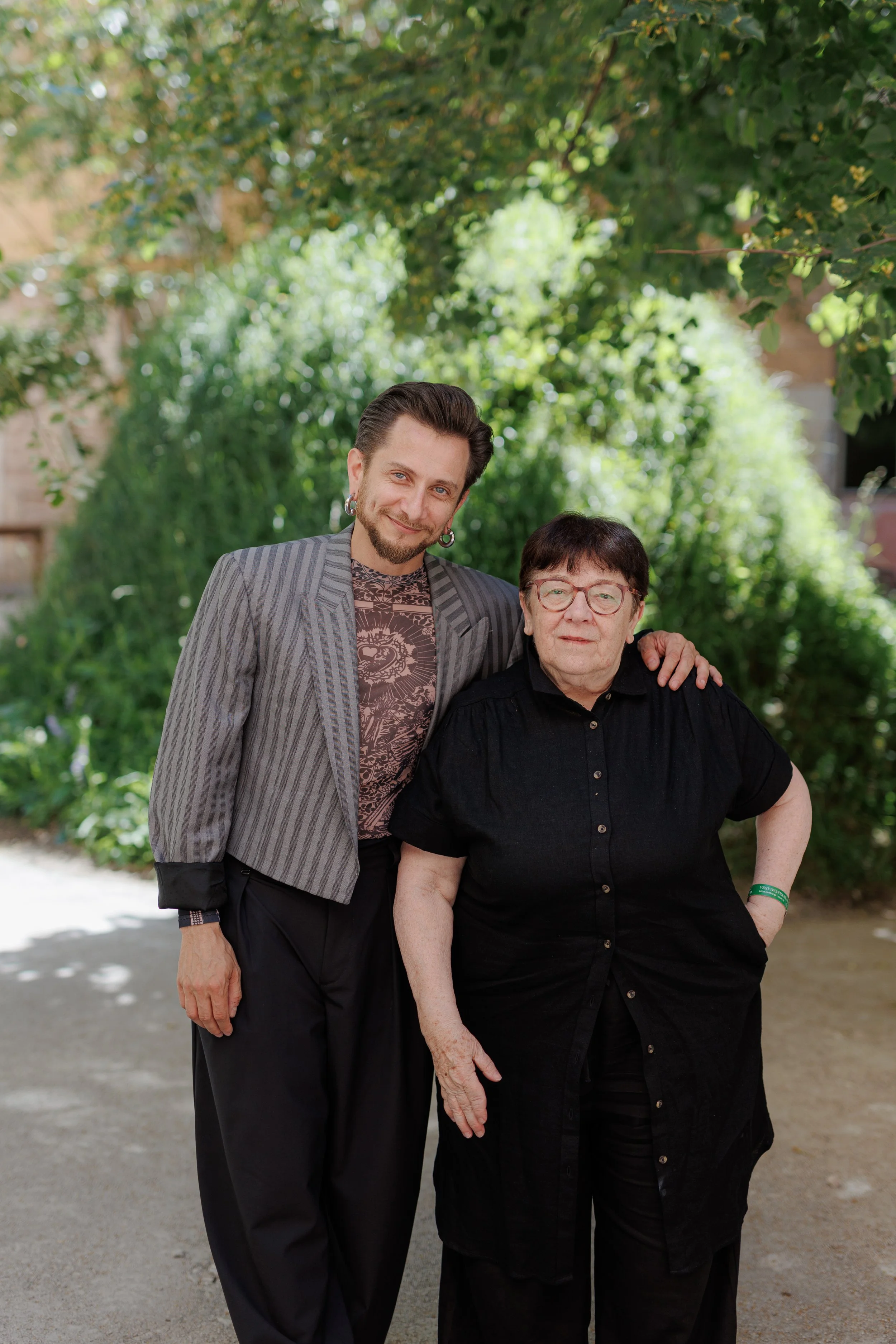
Alex Mirutziu and Liviana Dan at the opening of Transilvania | Extravaganza (Photo: YAP Studio)
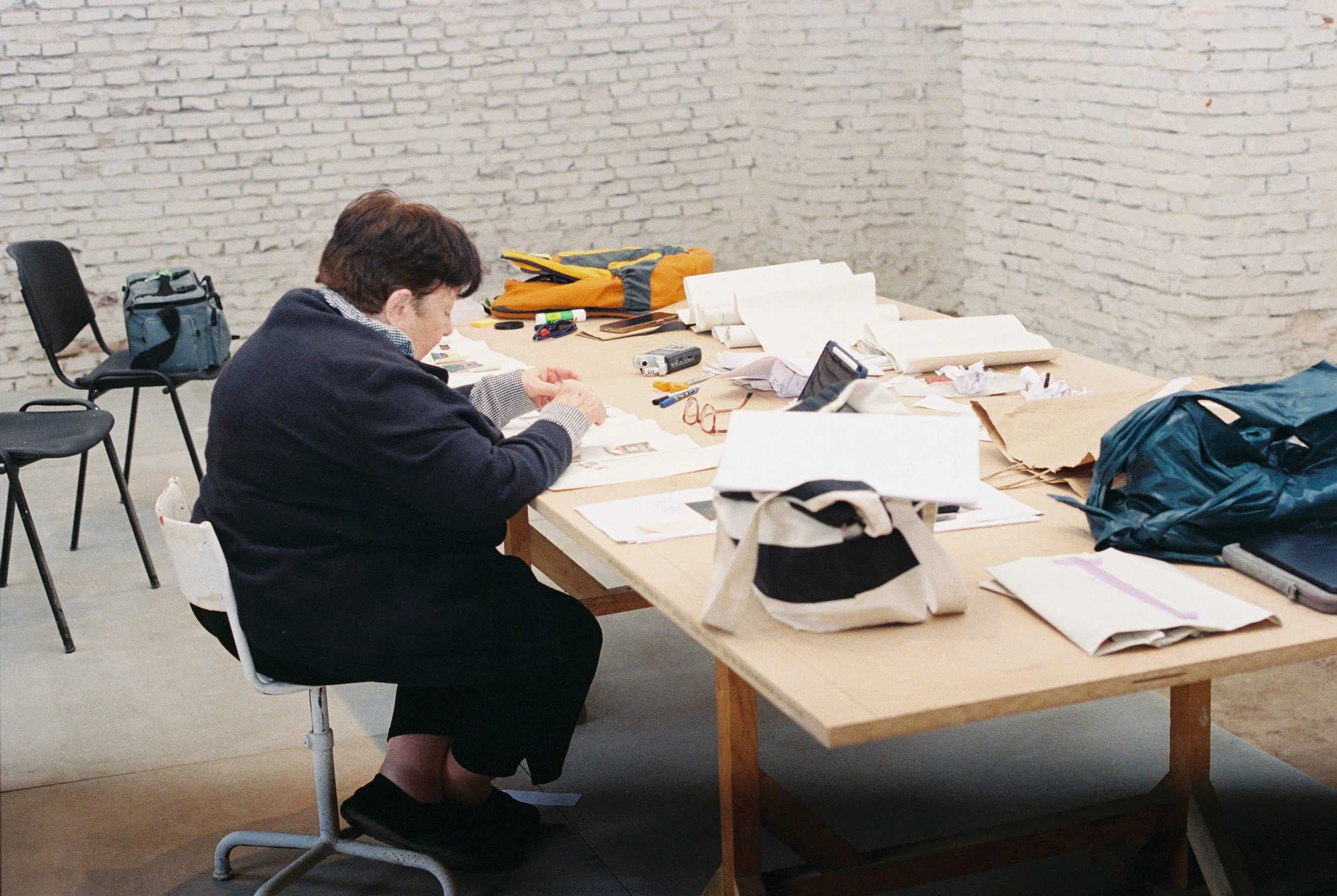
Notes from an assistant curator on Ștefan Câlția, Transylvania, and the making of a new language
Transylvania | Extravaganza begins by refusing Transylvania as an image. Curated by Liviana Dan around the work of Ștefan Câlția and installed inside the former Pedagogical School of the Ursuline Monastery in Sibiu, the exhibition does not restore a world, illustrate a region, or secure Câlția inside the familiar mythology built around him. It unsettles all three. I entered this process as her assistant, close enough to see how Liviana Dan thinks before an exhibition acquires its public form: through distances, materials, drawings, references, corrections and decisions sometimes measured in centimetres. What emerged was not simply an exhibition architecture, but another grammar for looking at Stefan Câlția, and perhaps for looking at Transylvania itself.
If we clean, we shall see
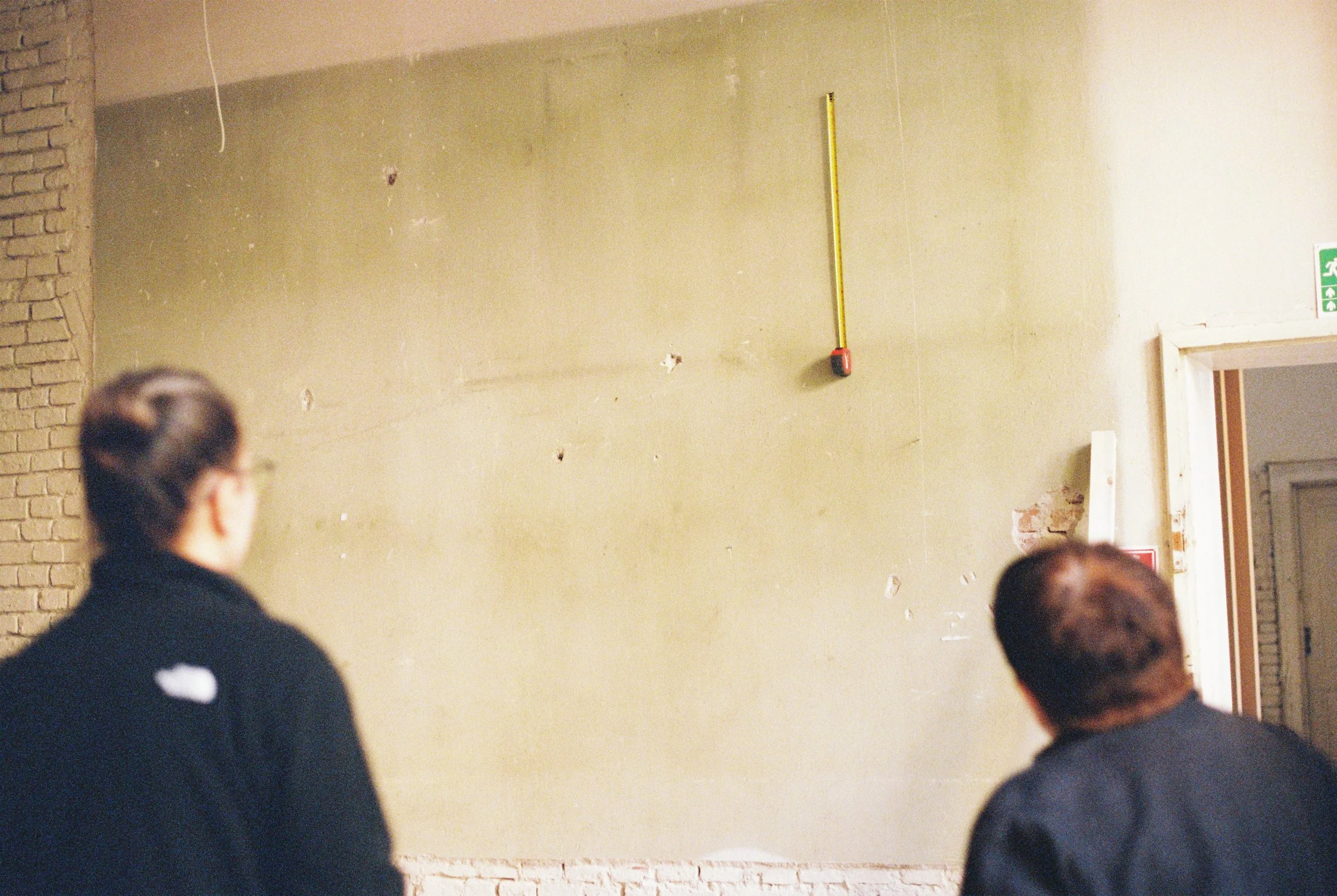
On November 10, 2025, we entered the Ursuline Convent with a principle already taking shape: no concealing, no obscuring the core reality of the dilapidated building. Liviana looked at the walls. “Not restoration,” she said. “Cleaning. A deep cleaning.” I wrote it down: cleaning, not correction. The distinction was characteristic of her. The building did not have to be rehabilitated into neutrality before it could receive art. Its stains, abrasions, uneven surfaces and accumulated fatigue were conditions to be understood, not defects to be erased.
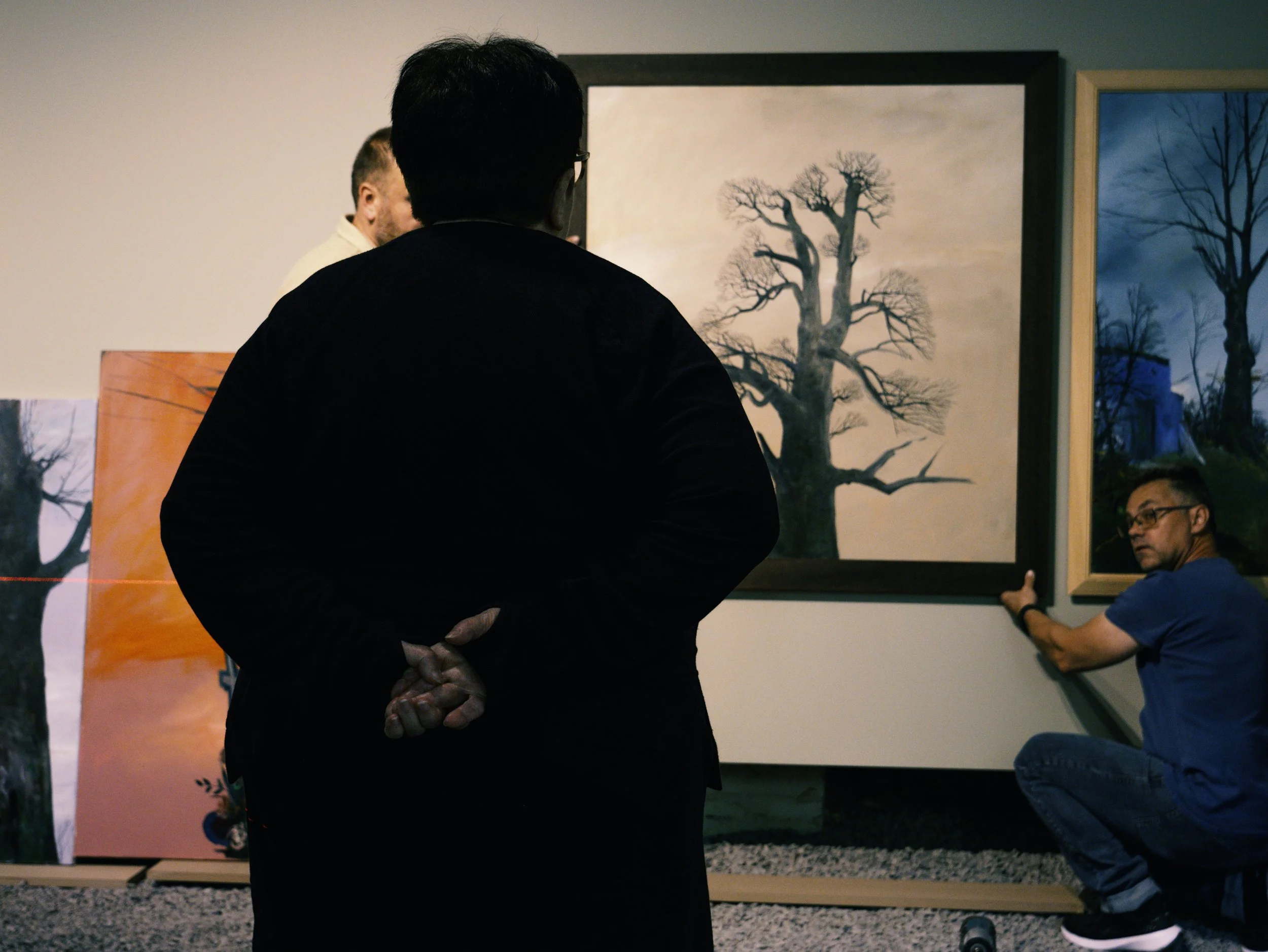
The conversation soon moved from the building to the paintings. The distance between painting and wall became a subject in itself. A few centimetres could alter the relationship between image, support and architecture. I wrote in my notes: “the pneumatic interval between surface and support.” Natural light was another recurring concern. We agreed to keep as much of it intact as possible and to adjust very little. Liviana insisted that corners mattered and that the walls had to retain a life of their own. The display modules, meanwhile, should be lean. “The surprise is the art,” she said. Months later, early one morning when only Câlția and I were inside the finished exhibition, he stood in The World as Theatre, one of the sections most fully exposed to natural light, and told me how much he loved what happened there. The light had not been transformed into scenography. It simply entered. I remembered those first meetings and wrote: light is not scenography here; it is a condition of seeing.
The Cypress, and the delight of a curator who sketches
Many of the decisions that eventually entered the monastery were first discussed elsewhere. Liviana keeps among her working papers a postcard bearing a painting that has followed her through every place we have, for a while, called our office. A quiet companion, it is a meditation on mortality and transience simply called Cypress. Whenever we meet there, we drink hot chocolate with a splash of Stroh, mine always with whipped cream. December can be harsh in Sibiu. The weather turned against us with almost geometric crudeness: rain, sometimes snow, dampness gathering in the streets. Inside, the light settles gently as we settle our bodies, somehow childishly, around a round table near the restaurant kitchen.
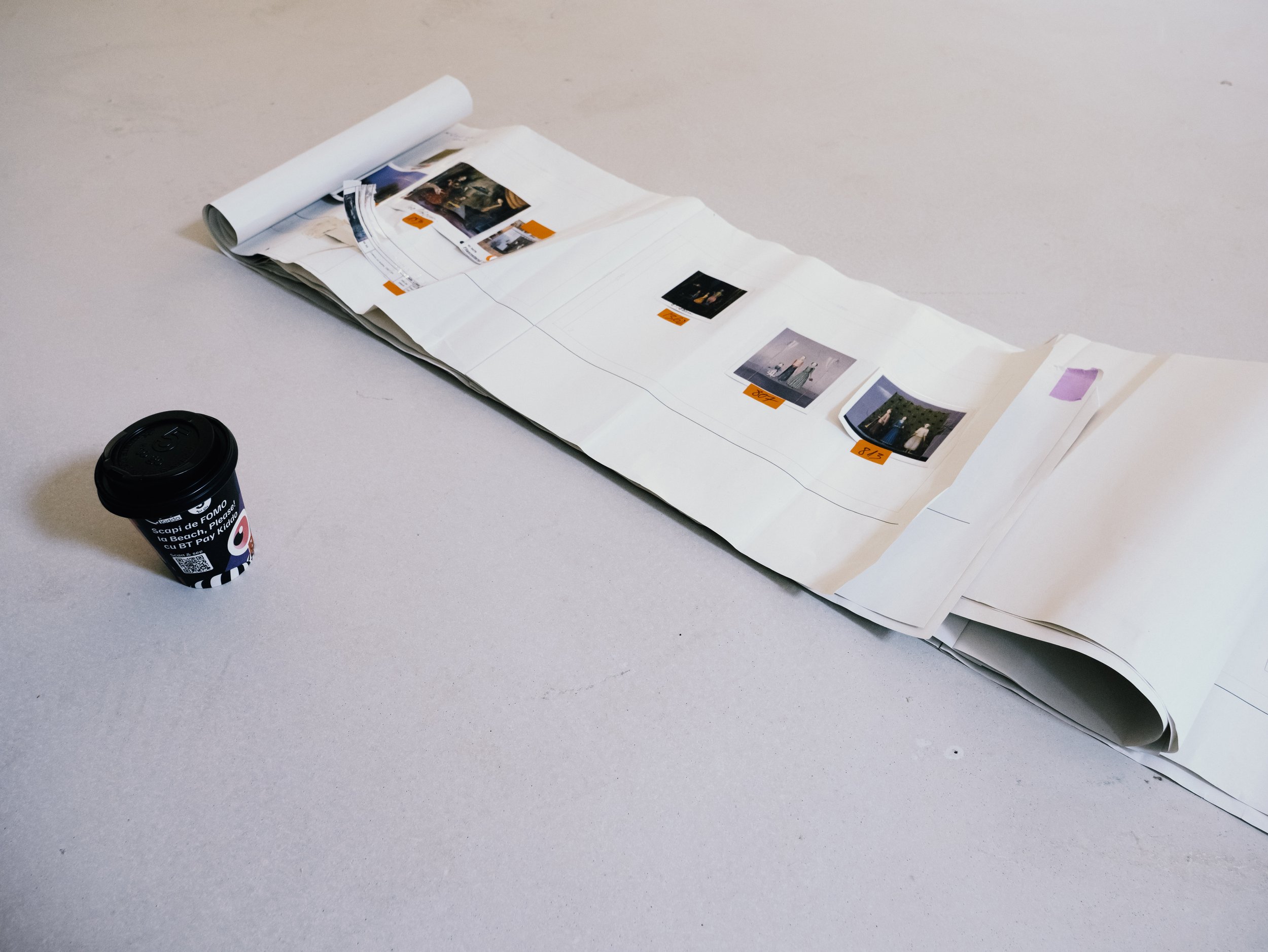
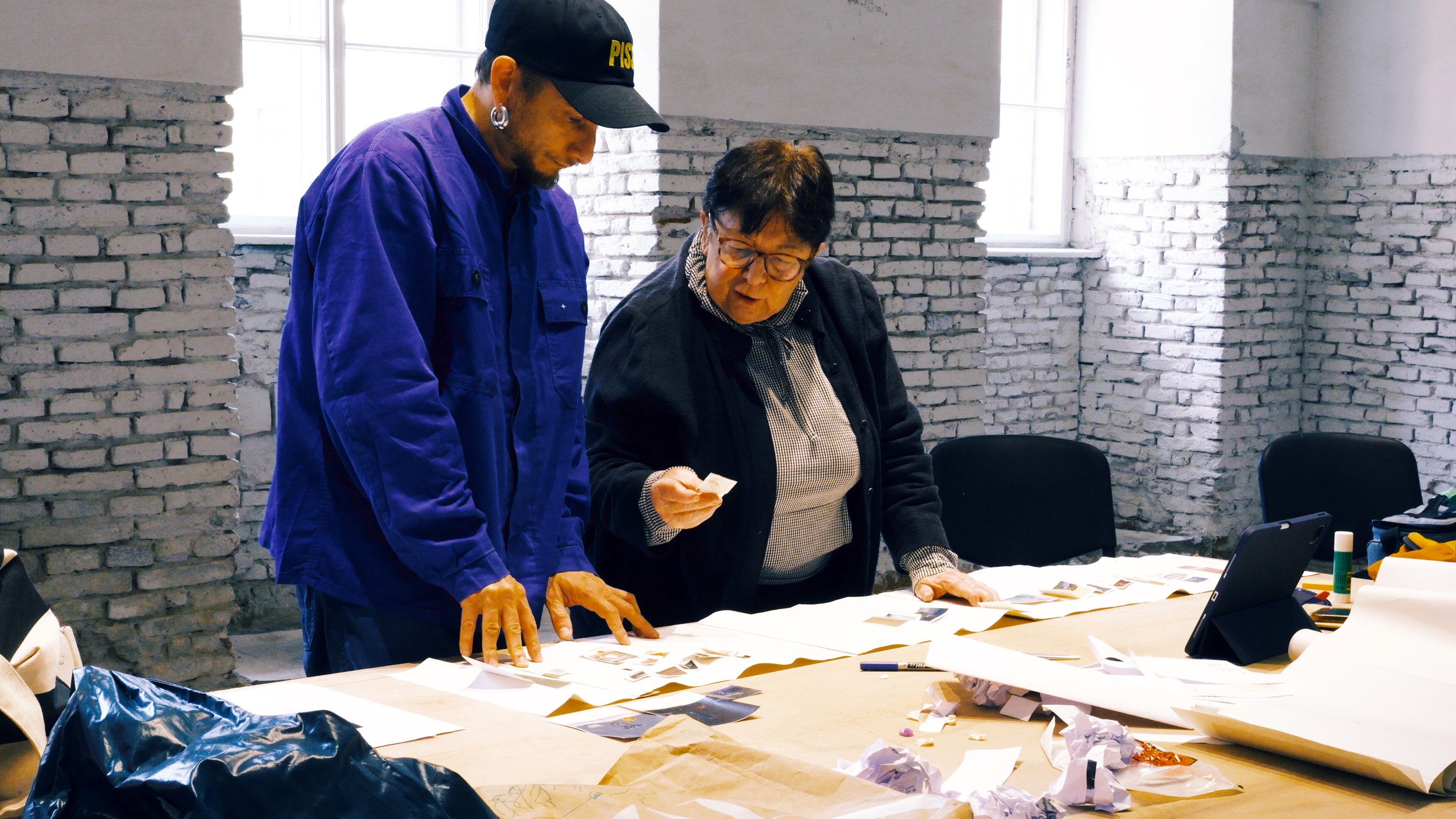
The sketchbooks remain open. Liviana uses the same brand of ballpoint pen, always the same thickness, and I have become familiar with its movement across the page as she traces walls, corners and possible trajectories through the exhibition. I am happy when she draws for me. I follow the course of the line while my hands on the iPad keyboard interrupt the flow of speech and dictation, to which I remain a humble servant. Her thoughts often arrive as fragments and then acquire direction. Lines become paths; meetings unravel into suggestions, material boards and architectural solutions. References accumulate, but they rarely function as demonstrations of erudition. Liviana wants to know what a particular example can do to the problem immediately in front of us.
On December 2, she asked me if I knew why locomotion in Câlția’s paintings is never quite resolved, why movement appears suspended or withheld rather than fully delivered. She spoke about the mist in the paintings and how suggestive it could become, about roses seeming to breathe through it. Then came a succession of benchmarks, almost like conceptual glottal attacks: cloud white, septic spaces, no scenography, austere, Protestant, intimate light. “You cannot get Câlția if you don’t walk the walk,” Liviana argued. For her this was not a stylistic prescription but something closer to a spiritual imperative.
And I fell in love with those gardens
“Look at Gardens for Dinu Pillat and at the sadness held there,” she said. Our discussion of Câlția’s works increasingly entered a sensory register. One painting suggested galbanum, damp cedarwood, petrichor, something mineral underneath. Another seemed nocturnally suspended, colder than marine, almost ozonic. I told her that the extraordinary cyan field suggested wet stone and perhaps a metallic note. Dinu Pillat died on December 6, 1975, with the conviction that beyond this life he might recover some peace and begin to write again, this time in a garden of flowers. Câlția has made such a garden for him, but it is not consoling. Its bleakness seems almost severe, as though comfort had to be stripped away before the work could begin to act directly on the body.
Towards building a grammar
This ability to displace perception is central to Liviana’s way of looking. For her, light can have a smell and night can turn into an organ. A wall is never merely a support, just as empty space is never simply empty. While we were working on the exhibition, she became absorbed by Álvaro Urbano, not by the plants in his installations as such but by what he makes them do: how they enter architecture, interrupt it, soften it and reroute it. We sat with my tablet between us and looked repeatedly at Prelude, shown at Marian Goodman in July 2025. What impressed us was not complexity but the opposite: how little was required when the gesture was exact.
From there we moved to Jil Sander and the Fall/Winter 2025–26 collection. Liviana has loved the brand for years, and I began to understand why. There is something Jil Sander-like in the way she thinks, not minimalism as style but restraint as method, an exact economy of gesture and a mistrust of ornament. One precise intervention can carry more force than ten expressive ones. This was also how she approached the exhibition. The question was rarely how much could be added; it was how much could be removed before the space began to speak on its own.
On repeated visits to Liviana’s home, we also talked about Barbara Hepworth, about matter and space and about the hole that intensifies the form surrounding it. Emptiness, in this sense, is not lack but pressure. Henri Frankfort compared sculpture to music through a similar logic: silence participates in rhythm rather than interrupting it. The comparison helped me recognise something I had already been watching Liviana do. She does not fill space; she activates intervals.
Life through ricochet, or death through visibility
Long before Transylvania | Extravaganza began, Liviana and I had spoken about the generation formed in Romania during the 1980s and about what it meant to make art inside a system governed by censorship, surveillance, informers and professional intimidation. Yet censorship alone is too simple a word for the climate we were trying to describe. It suggests a visible prohibition: a red line, a work removed from a wall, a sentence officially forbidden. Pressure often operated less directly. It travelled through institutions, friendships and careers, through the suspicion that somebody might be listening and through sentences shortened before they were spoken. It entered the room before anything explicit had occurred.
People learned another language. They learned to withhold, substitute and disguise, to recognise the second meaning concealed inside the first. The famous șopârle, the political insinuations and coded jokes of the period, belonged to this culture of indirectness. Liviana has always been suspicious of the ease with which such devices can later be romanticised. Political metaphor itself could become a convention or an easy solution, another way of avoiding the difficult encounter with the object and with form.
Heterogeneous identity and the metaphoric urgency
Her own formation was sustained by a different kind of interiority. At the Brukenthal Museum she had access to an extraordinary cabinet of prints and to a serious library. Around her were books, archives, conversations and figures of formidable refinement, among them Mircea Ivănescu and Paul Petrescu. In a period of fragmented information and ideological pressure, intellectual life could become a kind of private architecture. One built an interior in which thought could remain exact. This history helps explain the seriousness Liviana later brought to exhibitions. An exhibition could not merely be assembled. Reusing an architectural solution without thinking it through again, repeating a conceptual path or accepting a convenient answer where a precise one was possible weakened the coherence of the whole.
That demand for coherence, however, does not result in rigidity. Its purpose is to preserve the work’s ability to resist a final interpretation. Câlția has long been surrounded by a familiar vocabulary: Transylvanian, archaic, mythical, rural, spiritual. Liviana does not necessarily reject these words; she refuses to allow them to finish the paintings. Categories close things too quickly. They give certainty where she would rather retain tension.
This is where the question of visibility begins to connect the exhibition to a larger historical experience. Under dictatorship, visibility could be dangerous. To become legible to the wrong person or institution could have consequences, and opacity could become a form of protection. Meaning migrated into omission, hesitation and disguise. Câlția’s figures often inhabit a similarly unsettled territory. They gather but do not entirely disclose themselves. There are masks, evasions, suspended gestures and strange proximities; something passes between figures, but we are not always given access to it. This should not be reduced to an illustration of communism. The connection is more intimate and less literal: these paintings appear to know something about what it means to preserve a part of oneself from complete visibility.
Even now, archives continue to alter the past retrospectively. Familiar names can return as informers, collaborators, frightened witnesses or compromised human beings, and with them the meaning of remembered rooms, friendships and acts of tenderness can shift. Trust itself becomes historical material. In such a context, subtext was not simply a literary device but a way of organising life. What mattered could survive in the hesitation, the omission or the gap. Absence was not necessarily empty; under certain conditions it could become the place in which meaning was most carefully protected.
The question is therefore not simply what Câlția makes visible but how his paintings allow things to appear without giving themselves away entirely. This is also what I have watched Liviana construct in the monastery. She does not force the work into visibility. She establishes the conditions under which it can appear without being exhausted by its appearance. Natural light matters for this reason, as do corners, intervals and the few centimetres separating a painting from a wall.
A light that is non-negotiable is a light that comes from within
Behind Câlția’s treatment of light there is also an older conception of radiance, close to the medieval and classical understanding of lux divinitatis, in which light does not only strike an object from outside but can appear to emanate from being itself. Câlția seems to retain something of this belief, which places him in an unusual tension with modernity, where illumination is increasingly manufactured, directed and calibrated by an exterior apparatus. In Câlția’s paintings, light can behave as though it had memory. Liviana understands this without sentimentalising it. She does not construct an archaic sanctuary around the painter; she lets that older radiance come into contact with a contemporary exhibition apparatus.
The Ursuline Monastery is crucial because it is not neutral. Its surfaces already contain duration, its light changes throughout the day, and its architecture refuses the white cube’s fantasy of a space without history. Câlția’s paintings enter a building that has already had other lives and must negotiate with them. A few centimetres alter the relation to a wall; daylight changes the same room over the course of a day; visitors inhabit positions we did not necessarily predict. Precision, in Liviana’s practice, does not eliminate contingency. It gives contingency form.
Transylvania enters the exhibition through the same refusal of fixed categories. It is not treated as a stable identity or as scenery but as a place formed through improbable coexistences. Geographically and politically, the region has been shaped by overlapping Habsburg, Ottoman, Hungarian, Romanian and Saxon histories. Ideas, books, objects, liturgies and architectural forms circulated through it. Later, America entered family histories as people crossed the Atlantic, sometimes returning and sometimes remaining there, carrying back photographs, objects and habits.
This is where the extravagance of Transylvania | Extravaganza lies. It is not primarily luxury or excess in the conventional sense, but the excess produced by coexistence. The ordinary world contains too many historical layers to remain entirely ordinary. A church, a carpet, a meal, the thickness of a wall or the position of a window can all carry histories that intersect without cancelling one another. Transylvania produces an aesthetics of the site in which style arises from material, workmanship, proportion and endurance rather than being applied afterwards as decoration. Quality sustains style, and modest means can still produce extraordinary force.
Câlția’s obstinacy and Liviana Dan’s freedom of thought
This is also where Liviana finds Câlția beyond the familiar vocabulary of folklore and nostalgia. She locates him in a territory whose contradictions are too numerous to be resolved into a single story. Her curatorial task is less to explain his world than to prevent it from being reduced. The discipline she developed through archives, books, mentors and the protection of an interior life returns here as a method of attention.
After 1989, the surrounding pressure changed. The opacity of dictatorship was followed by the accelerated production of visibility, novelty, market value and circulation. Liviana remained sceptical of both systems. One demanded ideological conformity; the other demanded immediate legibility. Her resistance to both can be found in the same attention I have watched throughout the making of this exhibition: attention to the wall before the painting reaches it, to the centimetres of air behind a frame, to whether another light is necessary, and to the precise moment when another intervention would make the exhibition poorer rather than richer.
Perhaps this is the radiant nucleus of her work with Câlția: the conviction that things must be allowed to possess more reality than our explanations of them. A painting cannot be reduced to its iconography, Transylvania to its mythology, light to illumination or silence to absence. An exhibition, in this sense, is not a container but a temporary structure in which matter, history, intellect, sensation and emptiness are brought into a sufficiently precise relation for something to become present without being fully explained.

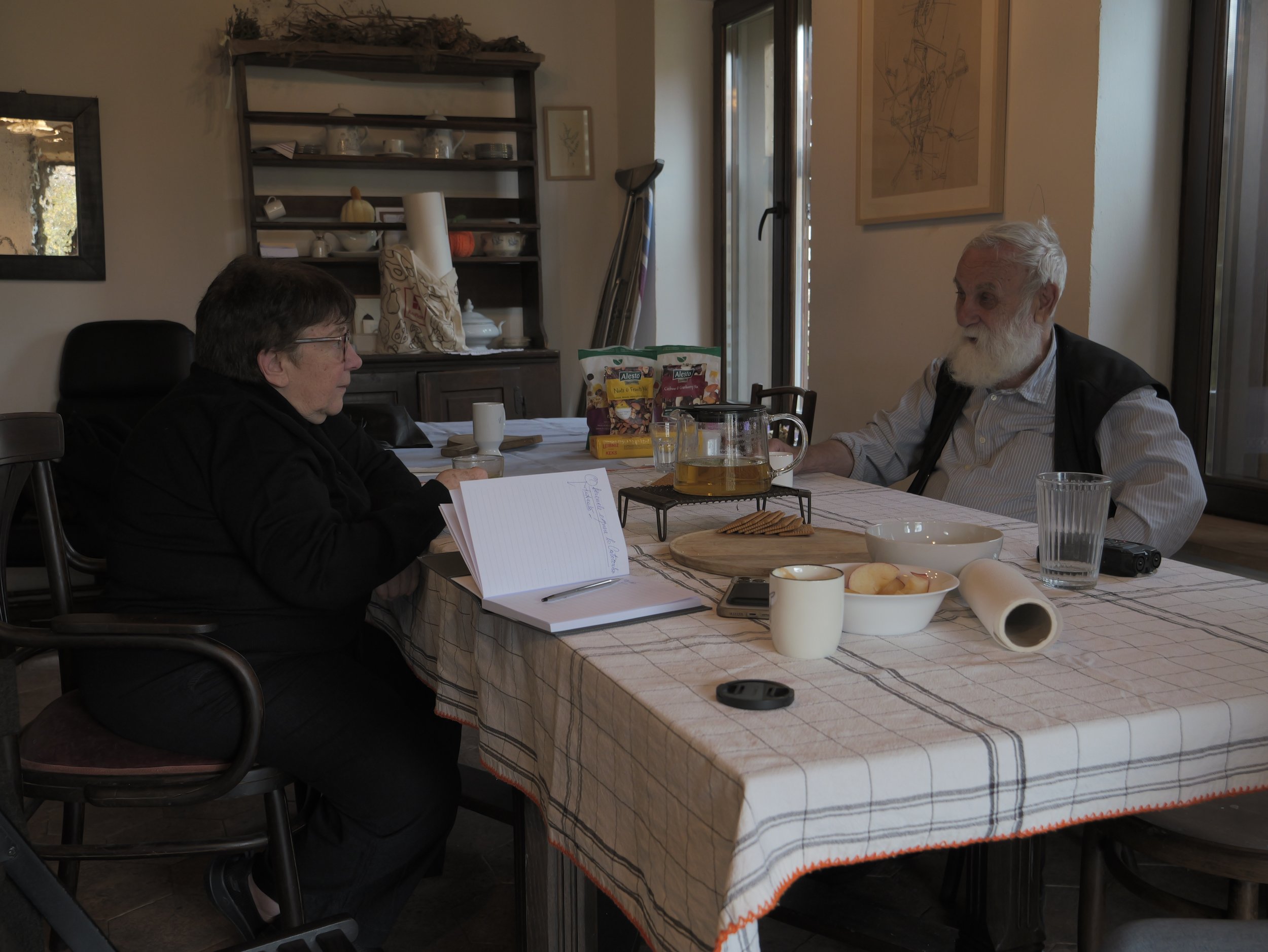
Artist Stefan Caltia and curator Liviana Dan in Bucharest-studio, 2026