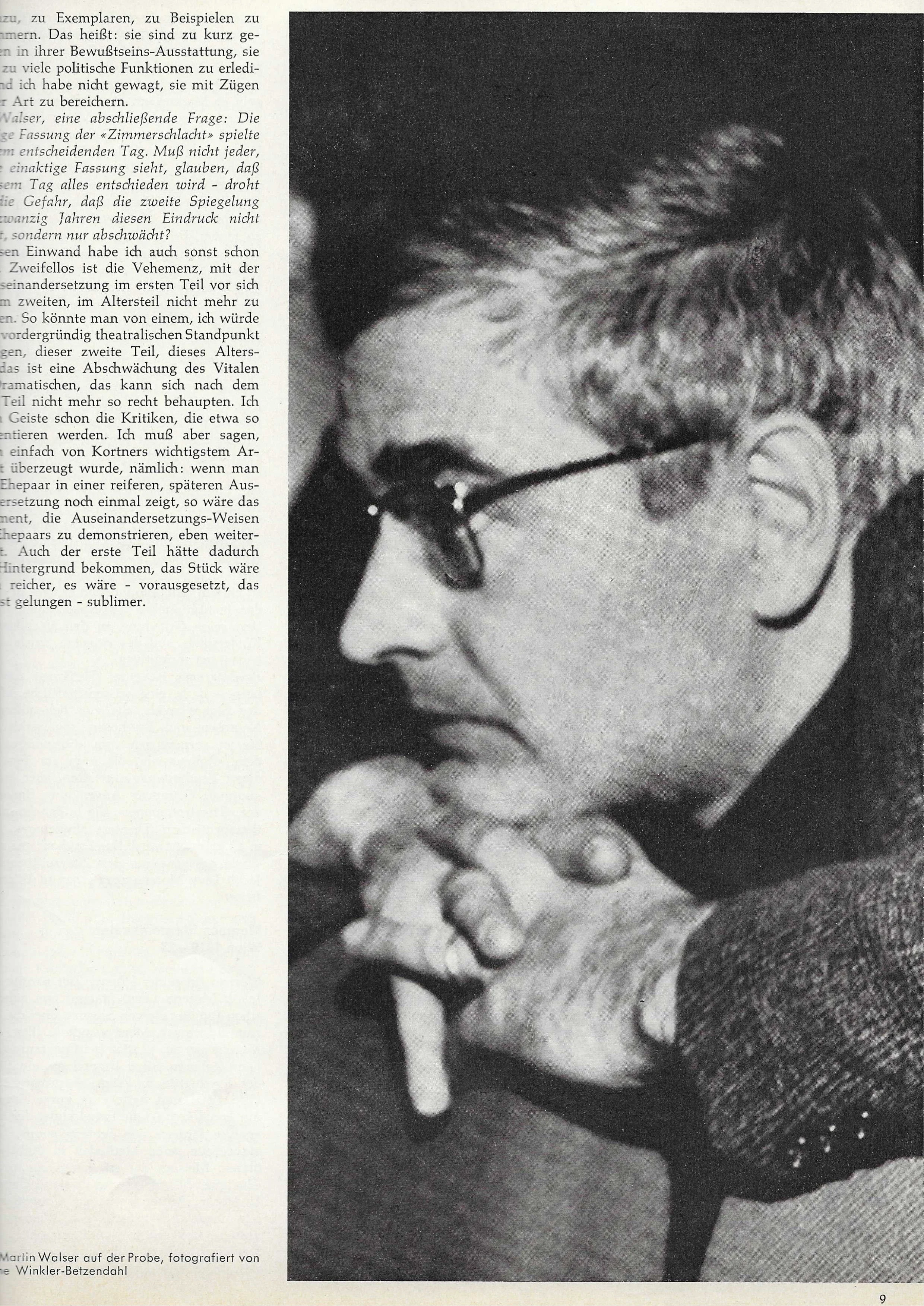
Adio politicii?
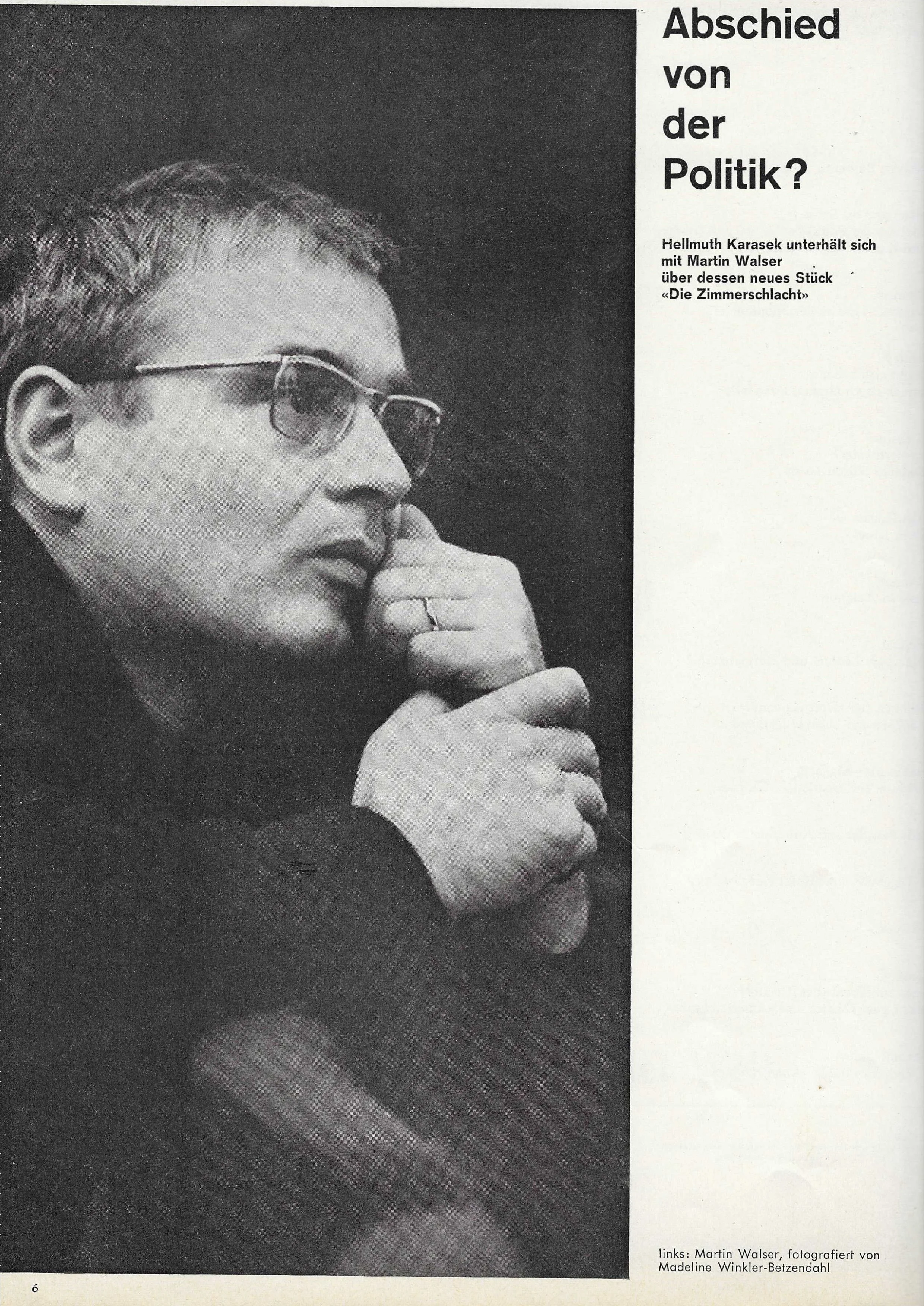
Hellmuth Karasek în dialog cu Martin Walser despre noua sa piesă „Bătălia din dormitor”
Interviu extras din Theatre Heute, 9 septembrie 1967
RO
Domnule Walser, în octombrie va avea loc la München premiera piesei dumneavoastră „Bătălia din dormitor”, în regia lui Fritz Kortner. Poate fi și noiembrie. Câteva luni mai târziu, televiziunea va difuza, de asemenea, „Bătălia din dormitor”. Este vorba despre aceeași piesă sau spectacolul de teatru va fi diferit de versiunea televizată?
Este vorba, desigur, de aceeași piesă, dar nu de aceeași versiune. Varianta pentru televiziune este cea pe care am scris-o în iarna lui 1962/63, într-o formă într-un act. Am lăsat-o atunci deoparte; era după „Stejar și angora”, iar piesa mi se părea, tematic, puțin prea privată. Credeam că teatrul ar trebui să se ocupe în primul rând de confruntări politice.
Totuși, am dat-o la radio; a fost difuzată cam acum un an și jumătate. Fritz Kortner a auzit de ea, a cerut manuscrisul și mi-a spus: această piesă, care se petrece într-o singură seară și are ca subiect confruntarea unui cuplu căsătorit — subtitlul este „O piesă-exercițiu pentru cupluri” —, nu ar trebui să se limiteze la acea seară; i s-ar părea interesant dacă aș încerca să arăt cum acest cuplu privește înapoi la acea seară peste 10 sau 20 de ani. Ce a rezultat între timp, s-a schimbat modul de luptă al cuplului odată cu înaintarea în vârstă?
Mi s-a părut o sugestie fertilă. Am plecat acasă, am încercat, și astfel, din piesa într-un act de atunci, a ieșit o piesă în două acte pentru teatru. Dar, cum spuneam: la televiziune rămâne versiunea care tratează doar o singură seară; nu există un salt temporal, lucru care probabil se potrivește și mai bine pentru televiziune.
Am două întrebări legate de asta. Prima:
Ați spus că inițial piesa vi se părea prea privată. Este o exagerare dacă spunem că între piesele dumneavoastră de atunci și romane — deci între Walser dramaturgul și Walser romancierul — exista o prăpastie mai mare decât cea reflectată în „Bătălia din dormitor”?
Da, cu siguranță. Pe atunci nu consideram posibil în teatru nimic altceva decât parabole, după modelul lui Brecht, cu personaje din materia parabolică din care sunt făcute și figurile brechtiene. Și adesea mi se părea de neînțeles că, odată cu experiența mea de romancier, care se adună de la sine, nu puteam face, pe scenă, aproape nimic. Credeam: nu trebuie să analizez asta ca un inginer; se va rezolva de la sine.
Și cred că s-a rezolvat acum, pentru că nu aș fi putut prelua sugestia lui Kortner dacă nu s-ar fi schimbat și concepțiile mele despre posibilitățile teatrului — adică nu mai formulez și nu mai consider adevărată, ca atunci, prioritatea temei politice pe scenă.
Aici pare posibil un mic neînțeles.
Înseamnă asta că piesa „Bătălia din dormitor” este „privată” în sensul că vedeți reprezentarea politicului posibilă doar printr-un alt tip de traducere, printr-un alt grad de distanță față de sine?
Da, am trăit această experiență pe propria piele; poate fi o experiență care se aplică doar mie. Pentru mine nu este corect să mă apropii direct de tema politică. Ar trebui să las piesa, indiferent ce se întâmplă, mai aproape de propriile mele experiențe, într-un fel de zonă „mai apropiată de piele”. Este mai potrivit pentru mine dacă o hrănesc în principal cu propriile mele conținuturi de conștiință — și anume cu dificultățile propriei mele conștiințe —, decât să mă erijez în executor al unei problematici publice pe care o simt foarte presantă și despre care cred că ar trebui abordată imediat. Așa a fost în „Stejar și angora”, în „Krott” și în „Lebăda neagră”. Atunci credeam: există probleme, există ceva înțepenit și reprimat în opinia publică; mă implic acum direct în confruntare, aproape fără a ține seama de mine însumi, ca să exagerez puțin. Și am ales atunci calea parabolei, calea fabulei semnificative, care, prin desfășurarea ei, oferă un fel de mod de tratare sau chiar de soluționare, cel puțin o posibilitate de a vorbi despre această temă publică.
Această funcție aproape pedagogică pe care piesa încerca să o preia mi-a devenit, cu fiecare an, tot mai străină; astăzi aș extrage totul mai degrabă din materia propriei mele conștiințe decât din materia opiniei publice.
Căsătorie și societate
„Bătălia din dormitor” face public un subiect nepublic, care se desfășoară într-un spațiu închis. Dar, din moment ce ați menționat că respingeți intențiile pedagogice sau parabolice, aș întreba totuși: ce înseamnă subtitlul „O piesă-exercițiu pentru cupluri”? Nu se ascund aici totuși pedagogia și parabola?
Subtitlul este gândit aproape ironic. Ceea ce se petrece pe scenă este exagerarea unei lupte care se desfășoară în mai multe runde, într-un mod comic sau trist; este și încercarea de a obiectiva metodele de luptă ale unui cuplu căsătorit. Să presupunem că intenția mea ar fi fost să obiectivez; atunci puteam face și acest mic pas și să spun: iată, este chiar o piesă-exercițiu — dacă voi, cei din public, încercați cu propria voastră conștiință să „repetați” ceea ce se desfășoară aici, poate veți câștiga și voi o distanță față de voi înșivă, așa cum am câștigat eu distanță în timp ce, scriind, m-am obiectivat pe mine însumi. În acest sens, piesă-exercițiu.
Poate și în sensul că arătați ce forțe, excluse din sfera publică, sunt pur și simplu consumate într-un eroism domestic — care poate părea atât comic, cât și foarte tragic — atunci când vrei să-ți duci viața la capăt într-un mod cât de cât ordonat?
Da, piesa are o problematică socială; nu este una intenționată, dar piesa este, ca și celelalte, un experiment pe care îl faci pentru a te lămuri. Atunci, în piesele politice, experimentul era să aflu cât de mult sunt implicat, cât de mult mă pot implica, dacă am ceva de oferit. De data aceasta, experimentul unei piese despre căsătorie a dus la concluzia că un cuplu, fără legătură cu societatea, trebuie, într-un fel, să se îmbolnăvească — că această celulă, celebra celulă familială, nu este viabilă de una singură. Piesa are o constelație în care, de fapt, societatea ar trebui să fie prezentă, dar, printr-o măsură a bărbatului, căsnicia trebuie să se descurce singură în acea seară, iar asta arată că nu este capabilă de așa ceva.
Cerem prea mult piesei dacă mergem un pas mai departe și spunem că ea arată, poate, și cum instituția căsătoriei însăși trebuie să pară bolnavă în anumite condiții?
Piesa are, probabil, un punct de plecare care dezechilibrează un echilibru, prin faptul că cineva nu dă doi bani pe echilibre — anume cel care împiedică cuplul să ajungă în societate. Echilibrul este tulburat de faptul că un cunoscut, de aproximativ 40 de ani, se desparte de soția lui și își ia una foarte tânără; ceilalți din jur nu suportă prea bine acest lucru…
Fiecare căsnicie — un teatru…
… pentru că, în fond, poate și ei și-ar dori asta…?
… dar se abțin și nu sunt în stare, din diverse motive. Ei trebuie să-și continue vechile legături. Asta duce la faptul că acest cuplu rămâne singur. Și mai important este că un cuplu trebuie să petreacă singur o seară și că această seară devine acum exemplară, pentru că trebuie să folosească toate abilitățile conjugale dobândite pentru a se înțelege. În această seară, claviatura conviețuirii este cântată mai conștient ca de obicei; acum devine necesar, acum ar trebui să dea efect, să dea roade — tot ceea ce ai învățat despre menajare, prudență, nici prea mult, nici prea puțin. Este comic — și iarăși nu comic — că acest lucru nu reușește, că acest cuplu nu se descurcă cu acele abilități.
Cei doi au intenții bune unul față de celălalt, nu se urăsc deloc, duc o căsnicie normală, lipsită de probleme, dar sunt suficiente câteva schimbări pentru ca această normalitate să se răstoarne — și astfel se ajunge la luptă. Se vede: de îndată ce conviețuirea normală nu mai funcționează și abilitățile dobândite nu mai sunt suficiente, ei redevin indivizi separați, încep să se desprindă unul de celălalt; acum fiecare trebuie să-și dovedească propria autoafirmare, fiecare încearcă să se salveze, să fie mai puternic decât celălalt. Și atunci își dau seama că această luptă este cel mai dăunător lucru pentru această simbioză, pentru această comunitate dependentă de autarhie. Se împacă din nou, într-un fel, dar este o împăcare despre care nu se știe cât va dura.
Tema a devenit piesă de teatru poate și pentru că cei doi, în această situație excepțională, sunt constrânși încă de la început să joace teatru unul în fața celuilalt?
Da, nu știu de ce, dar stătea de mult timp în caietul meu de notițe sub forma unui dialog; a fost mult timp planul meu. Inițial avea titlul „Fericirea lui Zappel”. Atunci era gândit mult mai ușor — sau mai lejer — decât a ajuns să fie, dar pentru mine a fost mereu clar: este dialog, este dialog conjugal; nu aș fi vrut să-l îmbrac într-o narațiune care să-l neutralizeze.
Presiunea lui Kortner
Dacă tot vorbim despre chestiuni tehnice:
Vi s-a părut (dumneavoastră și domnului Kortner) că piesa, ca piesă într-un act, este pur și simplu prea scurtă pentru scenă, și de aceea ați scris pentru versiunea de teatru un al doilea act, după o pauză de 10, respectiv 20 de ani?
Pentru mine nu a fost niciodată o problemă. Am lăsat piesa deoparte din motive biografice-private, pentru că mi se părea prea puțin politică. Domnul Kortner a citit manuscrisul pentru radio și, se pare, i-a plăcut. Dar, fiindcă el îmi este net superior în maturitate și experiență de viață, a simțit — sper că nu din motive de durată scenică — nevoia unei forme de luptă mai avansate. Probabil i s-a părut interesant să arate acest cuplu încă o dată, într-un mod de confruntare avansat cu 20 de ani. Am avut câteva discuții cu el. M-a uimit câtă forță de convingere a dezvoltat Kortner; ceea ce spunea era pentru mine irefutabil. Nu erau discuții dramaturgice sau despre chestiuni practice de teatru, ci pur și simplu vorbea despre sine și m-a făcut curios dacă mi-ar fi posibil, în general, acest salt într-o situație mai matură, ulterioară. De aceea, după prima discuție, am plecat acasă cu un entuziasm care m-a surprins pe mine însumi și am încercat pur și simplu. Sub îndrumarea lui neînduplecată — m-a împins tot mai adânc în asta — am încercat. Inițial voiam ca al doilea act să se petreacă la 10 ani distanță; el a spus: să-l plasăm și mai târziu. Mi-a dat indicații de atmosferă. A fost pentru prima dată, în experiențele mele cu oamenii de teatru, când cineva mi-a propus ceva atât de intens și stimulativ. Dacă această a doua parte este reușită, atunci îi datorez totul domnului Kortner.
Îmbogățire prin privat
Ați spus că un motiv pentru îndepărtarea de parabola politică a fost faptul că nu vă puteați aduce experiențele imediate pe scenă. Nu vă pune a doua parte a piesei în fața unei probleme similare, în sensul că vă lipsește și aici experiența?
Vorbim, desigur, foarte grosier și foarte pe scurt. Desigur că și parabola politică necesită o experiență personală: supărarea, furia sau dezamăgirea față de o stare politică sunt o condiție prealabilă. Doar că, atunci, mă simțeam obligat să fac fabulele cât mai îndepărtate, cât mai generale și cât mai obiective, să aduc cât mai puțin din mine, nimic intern al conștiinței, ci să rezolv piesele ca pe niște sarcini publice. Personajele pieselor mele parabolice tindeau să se atrofieze în exemplare, în exemple. Adică: erau prea sărace în dotare de conștiință, aveau prea multe funcții politice de îndeplinit, și nu am îndrăznit să le îmbogățesc cu trăsături de ordin privat.
Domnule Walser, o ultimă întrebare:
Versiunea într-un act a „Bătăliei din dormitor” se petrecea într-o zi decisivă. Nu trebuie ca oricine vede această versiune să creadă că totul se decide în acea zi — nu există riscul ca a doua oglindire, după douăzeci de ani, să nu completeze această impresie, ci doar să o slăbească?
Am auzit această obiecție și din alte părți. Fără îndoială, vehemența cu care are loc confruntarea în prima parte nu mai poate fi atinsă în a doua, în partea vârstei. Dintr-un punct de vedere, aș spune, superficial teatral, s-ar putea afirma că această a doua parte, acest duel al vârstei, este o slăbire a vitalului și a dramaticului, că nu se mai poate susține pe deplin după prima parte. Îmi imaginez deja, în spirit, criticile care vor argumenta astfel.
Dar trebuie să spun că am fost pur și simplu convins de cel mai important argument al lui Kortner: dacă arăți acest cuplu încă o dată într-o confruntare mai matură, ulterioară, atunci experimentul de a demonstra modurile de confruntare ale unui cuplu este dus mai departe. Și prima parte ar căpăta astfel un fundal; piesa ar fi pur și simplu mai bogată, ar fi — presupunând că este reușită — mai subtilă.
Mr Walser, in October your play The Battle in the Bedroom will premiere in Munich, directed by Fritz Kortner. It may be November. A few months later, television will also broadcast The Battle in the Bedroom. Is it the same play, or will the stage production differ from the television version?
It is, of course, the same play, but not the same version. The television version is the one I wrote in the winter of 1962/63, as a one-act play. I put it aside at the time; it came after The Oak and the Angora Rabbit, and thematically the play seemed to me somewhat too private. I believed that theatre should concern itself primarily with political confrontations.
Still, I gave it to the radio; it was broadcast about a year and a half ago. Fritz Kortner heard about it, asked for the manuscript, and said to me: this play, which takes place over the course of a single evening and concerns the confrontation between a married couple—the subtitle is An Exercise Play for Couples—should not be limited to that one evening. He thought it would be interesting if I tried to show how this couple looks back on that evening ten or twenty years later. What has happened in the meantime? Has the couple’s way of fighting changed as they have grown older?
I found that a fruitful suggestion. I went home and tried it, and so the one-act play became a two-act play for the theatre. But, as I said, television will retain the version that deals only with a single evening; there is no leap in time, which probably suits television better anyway.
I have two questions concerning that. The first:
You said that originally the play seemed too private to you. Would it be an exaggeration to say that there was, at the time, a wider gap between your plays and your novels—that is, between Walser the playwright and Walser the novelist—than the one reflected in The Battle in the Bedroom?
Yes, certainly. At that time I could imagine nothing in the theatre except parables, following Brecht’s model, with characters made from the same parabolic material as Brechtian figures. And I often found it incomprehensible that, despite the experience I was naturally accumulating as a novelist, I could do almost nothing with it on stage. I thought: I do not need to analyse this like an engineer; it will resolve itself.
And I think it has resolved itself now, because I could not have taken up Kortner’s suggestion if my ideas about the possibilities of theatre had not also changed—that is, I no longer formulate, or consider valid, the priority I once gave to political subject matter on stage.
There seems to be a slight misunderstanding here.
Does this mean that The Battle in the Bedroom is “private” in the sense that you see the representation of the political as possible only through another kind of translation, through another degree of distance from yourself?
Yes, I have experienced this personally; perhaps it is an experience that applies only to me. For me it is not right to approach a political subject directly. I ought to keep the play, whatever happens, closer to my own experiences, in a kind of area “closer to the skin.” It suits me better if I feed it primarily with the contents of my own consciousness—namely, with the difficulties of my own consciousness—rather than appointing myself the executor of a public problem that I feel to be very pressing and that I believe ought to be addressed immediately.
That was the case with The Oak and the Angora Rabbit, with Krott, and with The Black Swan. At the time I thought: there are problems, there is something rigid and repressed in public opinion; I will now enter directly into the confrontation, almost without taking myself into account, to exaggerate a little. And so I chose the route of the parable, the route of the meaningful fable, which through its development offers a kind of treatment or even a solution—or at least one possible way of speaking about this public issue.
This almost pedagogical function that the play attempted to assume became increasingly alien to me with every passing year; today I would rather draw everything from the material of my own consciousness than from the material of public opinion.
Marriage and Society
The Battle in the Bedroom makes public a non-public subject, one that unfolds in an enclosed space. But since you have mentioned that you reject pedagogical or parabolic intentions, I would still ask: what does the subtitle An Exercise Play for Couples mean? Are pedagogy and parable not still concealed within it?
The subtitle is meant almost ironically. What happens on stage is the exaggeration of a struggle that unfolds over several rounds, in a comic or sad way; it is also an attempt to objectify the fighting methods of a married couple. Let us suppose that my intention was to objectify them; then I could take this small further step and say: look, it really is an exercise play—if you, the audience, try in your own consciousness to “rehearse” what takes place here, perhaps you too will gain a certain distance from yourselves, just as I gained distance while, through writing, objectifying myself. In that sense, an exercise play.
Perhaps also in the sense that you show what forces, excluded from the public sphere, are simply consumed in a kind of domestic heroism—which can appear both comic and deeply tragic—when one tries to get through life in a reasonably orderly way?
Yes, the play has a social problematic; it is not an intentional one, but the play, like the others, is an experiment one undertakes in order to clarify something for oneself. In the political plays, the experiment was to discover how deeply involved I was, how deeply I could become involved, whether I had something to contribute.
This time, the experiment of a play about marriage led to the conclusion that a couple, without any connection to society, must in some way become ill—that this cell, the famous family cell, is not viable on its own. The play creates a constellation in which society really ought to be present, but, because of an action taken by the man, the marriage has to manage on its own that evening, and it becomes clear that it is incapable of doing so.
Are we asking too much of the play if we go one step further and say that it perhaps also shows how the institution of marriage itself must appear diseased under certain conditions?
The play probably begins from a situation that upsets an equilibrium because someone does not care in the slightest about equilibrium—namely, the person who prevents the couple from reaching society. The balance is disturbed by the fact that an acquaintance, about forty years old, separates from his wife and takes a very young woman; the others around them do not tolerate this particularly well…
Every Marriage—a Theatre…
…because perhaps, fundamentally, they would like to do the same themselves…?
…but they restrain themselves and are unable to, for various reasons. They have to continue with their old relationships. This results in the couple being left alone.
And even more important is that a couple must spend an evening alone together, and that this evening now becomes exemplary, because they have to use all the marital skills they have acquired in order to get along. On this evening, the keyboard of living together is played more consciously than usual; now it becomes necessary, now it ought to have an effect, to bear fruit—all that one has learned about consideration, caution, neither too much nor too little.
It is comic—and then again not comic—that this fails, that the couple cannot manage with those skills.
The two have good intentions toward one another; they do not hate each other at all. They have a normal, unproblematic marriage, but a few changes are enough for this normality to overturn—and so the struggle begins.
One sees that as soon as normal coexistence stops functioning and the acquired skills are no longer sufficient, they become separate individuals again; they begin to detach themselves from one another. Each now has to prove his or her own capacity for self-assertion, each tries to save himself or herself, to be stronger than the other. And then they realise that this struggle is the most damaging thing possible for this symbiosis, for this community dependent on self-sufficiency.
They reconcile again, in a way, but it is a reconciliation whose duration remains uncertain.
Did the subject become a stage play perhaps also because, in this exceptional situation, the two are compelled from the outset to perform theatre for one another?
Yes. I do not know why, but it had been sitting in my notebook for a long time in the form of a dialogue; it had been a plan of mine for a long time. Originally it was titled Zappel’s Happiness. At that point it was conceived much more lightly—or more loosely—than it eventually became, but it was always clear to me: it is dialogue, it is marital dialogue; I would not have wanted to dress it up in a narrative that would neutralise it.
Kortner’s Pressure
Since we are speaking about technical matters:
Did it seem to you—and to Mr Kortner—that the play, as a one-act piece, was simply too short for the stage, and that this is why you wrote a second act for the theatrical version, taking place ten, or rather twenty, years later?
For me, that was never the issue. I put the play aside for private-biographical reasons, because it seemed insufficiently political to me. Mr Kortner read the radio manuscript and apparently liked it.
But because he is vastly superior to me in maturity and life experience, he felt—I hope not for reasons of stage duration—the need for a more advanced form of struggle. He probably found it interesting to show this couple once again, in a mode of confrontation advanced by twenty years.
I had several conversations with him. I was amazed by the force of conviction Kortner developed; what he said seemed irrefutable to me. These were not dramaturgical discussions or conversations about practical theatre matters. He simply spoke about himself, and he made me curious as to whether I would even be capable of making this leap into a later, more mature situation.
That is why, after our first conversation, I went home with an enthusiasm that surprised even me, and I simply tried.
Under his relentless guidance—he pushed me further and further into it—I tried. At first I wanted the second act to take place ten years later; he said: let us place it even further ahead. He gave me indications regarding atmosphere.
It was the first time in my experience with theatre people that someone had proposed something to me in such an intense and stimulating way. If this second part succeeds, then I owe everything to Mr Kortner.
Enrichment Through the Private
You said that one reason for moving away from political parable was that you could not bring your immediate experiences onto the stage. Does the second part of the play not confront you with a similar problem, in the sense that here, too, you lack experience?
We are, of course, speaking very crudely and very briefly. Naturally, political parable also requires personal experience: irritation, anger or disappointment with a political situation are prerequisites.
But at that time I felt obliged to make the fables as remote, as general and as objective as possible, to bring as little of myself into them as possible, nothing from the internal life of consciousness, but rather to solve the plays as though they were public tasks.
The characters in my parabolic plays tended to atrophy into specimens, into examples. That is to say: they were too poorly endowed with consciousness, they had too many political functions to fulfil, and I did not dare enrich them with traits of a private nature.
Mr Walser, one final question:
The one-act version of The Battle in the Bedroom took place on a decisive day. Would anyone who sees this version not have to believe that everything is decided on that day—is there not a risk that the second reflection, twenty years later, does not complete this impression but merely weakens it?
I have heard this objection from other quarters as well. There is no doubt that the vehemence with which the confrontation takes place in the first part can no longer be reached in the second, in the part dealing with old age.
From a point of view that I would call superficially theatrical, one might argue that this second part, this duel of old age, constitutes a weakening of the vitality and dramatic force, that it can no longer fully sustain itself after the first part. I can already imagine the critics who will argue along these lines.
But I have to say that I was simply convinced by Kortner’s most important argument: if you show this couple once again in a later, more mature confrontation, then the experiment of demonstrating the modes of confrontation within a couple is carried further.
And the first part would thereby acquire a background; the play would simply become richer, it would be—assuming it succeeds—more subtle.